If you need help with the patent law terminology in this article, please click on the articles listed in Context to get the procedural background. You can find hyperlinks to our dictionary-style definitions there.
Context:
- Nintendo’s Japanese patent infringement lawsuit against Palworld maker Pocketpair is not going to have any noteworthy effects (June 11, 2025 games fray article). Even if Nintendo overcame Pocketpair’s numerous defenses, an injunction would not have any practical effect and damages would be limited to a short period that does not include when most Palworld sales occurred.
- Nintendo’s attempts to obtain new patents, such as one that it might want to assert against Palworld Mobile (July 16, 2026 games fray article), have lately been unsuccessful.
Analysis: Let’s take a look at what actually happened. This is not an everyday patent infringement case where one company made an invention and patented it before the other engaged in outright theft. Instead, both Palworld’s early-access version (the one that launched in January 2024) and Palworld 1.0 launched without any of the infringements later alleged by Nintendo based on patents it obtained after Palworld’s launch. And even if there had been any infringements after those patents were granted, they’d have stopped within a matter of months: Pocketpair worked around those patents.
As we explained last year, Nintendo availed itself of a legal option called “divisionals” when deriving new patents from an older (2021) application (January 23, 2025 games fray article). Many patent holders do that. By “claiming back” priority to an earlier application, they can obtain patents that read on a later-released product without that product being novelty-destroying prior art. It is “prior”, but only prior to the new patent application, not to the old one.
That said, it’s one thing that this is a legal option and another that Pocketpair, when it originally launched Palworld, had no way of knowing what Nintendo was going to do:
- Palworld launched. No wrongdoing there, not even under the theories in Nintendo’s patent infringement complaint.
- Palworld became an overnight success with tens of millions of downloads.
- Nintendo started its saber-rattling with a public statement.
- Nintendo filed derivative patent applications.
- The Japan Patent Office (JPO) granted Nintendo some new patents.
- Nintendo took three of those new patents and sued Pocketpair (without even extending any warning to Pocketpair).
- Within a matter of months, and long before the launch of Palworld 1.0, Pocketpair worked around those patents: certain game mechanics were modified.
Here’s a chart that shows what happened in 2024 and the first half of 2025:
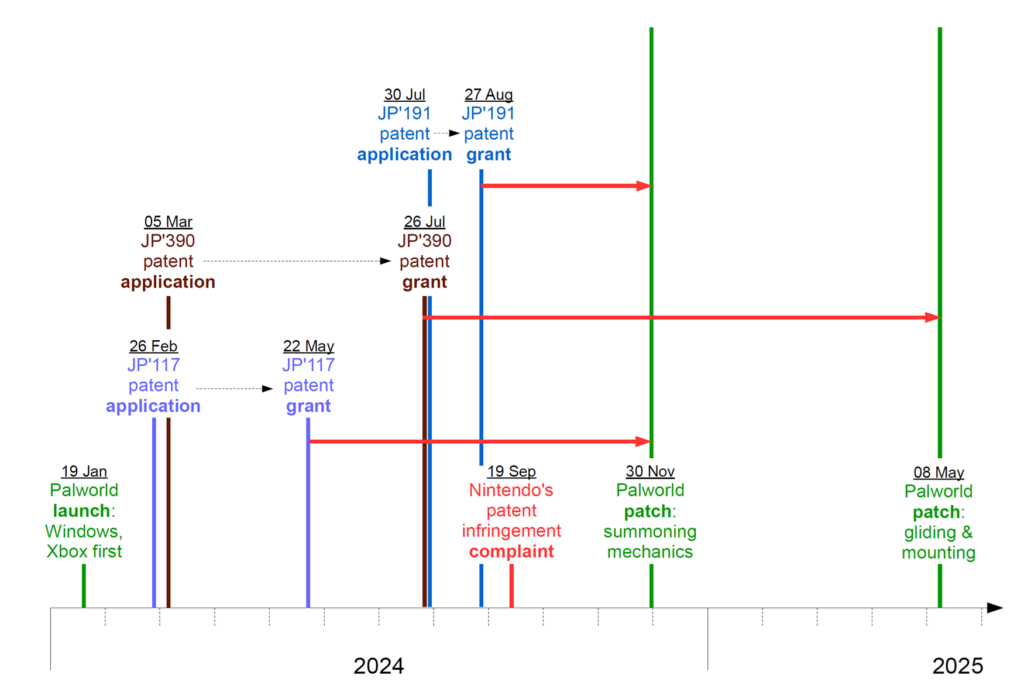
You can see that Palworld came first, the relevant Nintendo patent applications second. The patents were granted rather swiftly, and published after the fact. Review was so quick that Pocketpair didn’t even have the chance to act before the issued patents were published.
The red arrows show the periods for which Nintendo can claim damages (if it prevails on the merits in the first place, which is far from a given in light of Pocketpair’s defenses). For the ‘117 patent, that’s from May 22 to November 30, 2024. Most Palworld sales were booked during the first few months of that year. For the JP’191 patent, the period is even shorter: August 27 to November 30, 2024. And even for the JP’390 patent, it’s just from July 26, 2024 to May 8, 2025. Again, that is not when most of the revenues were generated.
The next chart is structurally similar to the previous one, but for each patent it focuses only on the period from grant to workaround. And it shows how much time passed between those workarounds and the launch of (undisputedly non-infringing) Palworld 1.0:
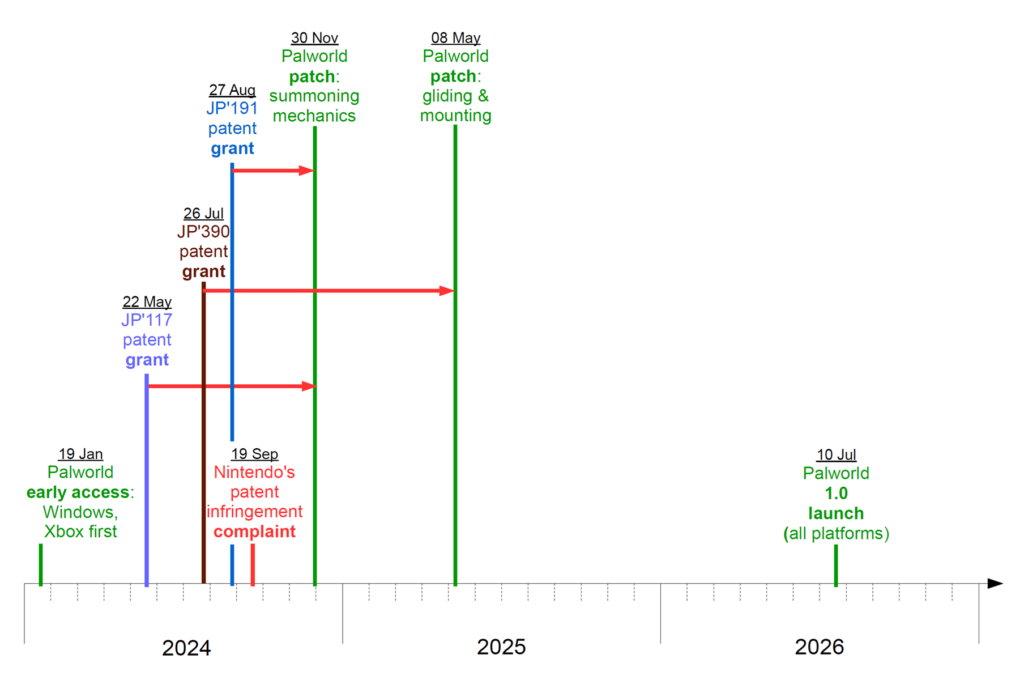
The sequence of events shows that Nintendo and The Pokémon Company are not victims of intellectual property theft. They were sitting on old (2021) patent applications and used them in 2024, after Palworld’s launch, to seek monopolies on conventional game mechanics.
Based on those three post-Palworld-launch patents, Nintendo cannot (and does not) seek any damages from Pocketpair related to the largest part of Palworld sales. From Palworld’s early-access launch on January 19, 2024 to the grant of JP’117 on May 22, 2024, there was no patent in place that Nintendo (or anyone else, for that matter) has claimed to be infringed by Pocketpair.
Nintendo wanted to sue. If Nintendo had wanted to avoid litigation, it could have reached out to Pocketpair after obtaining a given patent and asked whether Pocketpair was willing to modify its product accordingly.
The fact that there are some abstract similarities between Palworld and Pokémon does not support any patent infringement theory. The whole idea of the patent system is that patents get published in a register, allowing everyone to study them. Nintendo’s patents-in-suit were applied for after Palworld’s launch, and they were published even later.
There’s nothing that Pocketpair reasonably could have done. Pocketpair did not have a crystal ball. It could not anticipate future patents that did not exist at the time when Palworld was released.
There is a procedure called freedom-to-operate (FTO) analysis. It’s what companies do when they look at the relevant patent in a given field and ask themselves whether the product they are working on is likely to infringe. But such an FTO analysis can only give answers with respect to patents that actually exist at the relevant time. If one had to fantasize about patents that don’t exist yet but might exist later, no product could ever be made.